Emma Boundy Ill Never Fall in Love Again
| "I'll Never Autumn in Love Again" | ||||
|---|---|---|---|---|
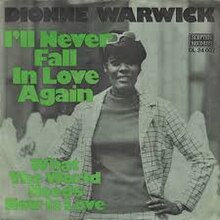 Artwork for German vinyl unmarried | ||||
| Single by Dionne Warwick | ||||
| from the album I'll Never Fall in Love Once again | ||||
| B-side | "What the World Needs At present Is Love" | |||
| Released | December 15, 1969 | |||
| Genre | Pop | |||
| Label | Scepter | |||
| Songwriter(southward) |
| |||
| Dionne Warwick singles chronology | ||||
| ||||
"I'll Never Autumn in Dearest Over again" is a popular song by composer Burt Bacharach and lyricist Hal David that was written for the 1968 musical Promises, Promises. Several recordings of the vocal were released in 1969; the virtually popular versions were past Dionne Warwick (released December 1969), who took it to number six on Billboard magazine'due south Hot 100[i] and spent 3 weeks topping the magazine'due south list of the about popular Piece of cake Listening songs,[two] and Bobbie Gentry (released July 1969), who topped the United kingdom of great britain and northern ireland chart with her recording[3] and too peaked at number 1 in Australia and Republic of ireland,[4] number 3 in South Africa[5] and number 5 in Norway.[six]
Promises, Promises [edit]
In the fall of 1968, Bacharach and David were in Boston for previews of Promises, Promises, the new musical for which producer David Merrick had asked if they would write the score, and Merrick realized, "We're missing a song in the middle of the second act, and what we demand is something the audience can whistle on their way out of the theater."[7] But around this fourth dimension, Bacharach was hospitalized with pneumonia and wasn't able to sit at a piano to write the music until after he was released. By that time "Hal had already come up with the lyrics to 'I'll Never Autumn in Love Once again,' and my infirmary stay had inspired him to write, 'What do you get when you kiss a girl? / You lot get plenty germs to catch pneumonia / After you do, she'll never phone you.'"[8] When he finally saturday with the lyrics in front of him, he recalls, "I wrote the melody for 'I'll Never Fall in Dear Once again' faster than I had ever written any song in my life."[7] The surge of creativity paid off. "We came in with the vocal the adjacent morning, and it went into the show a couple of nights subsequently. 'I'll Never Fall in Dear Once again' became the outstanding hit from the score and pretty much stopped the show every night."[7] Promises, Promises had its Broadway premiere on December 1 of that year,[9] and the vocal was originally performed equally a duet between the characters played by Jill O'Hara and Jerry Orbach as they ruminate on the diverse troubles that falling in love brings. They recorded it for the original Broadway cast album.[10]
Nautical chart hits [edit]
The first recording of "I'll Never Fall in Beloved Again" to reach any of the charts in Billboard was by Johnny Mathis, whose cover debuted on the magazine'southward Easy Listening chart in the effect dated May 17, 1969, and reached number 35 over the grade of iii weeks at that place.[11] Bacharach's own version, which was sung by a female person chorus, overtook the Mathis release afterward a May 31 debut on that same nautical chart and got as loftier as number 18 during its 9-calendar week stay.[12] It also peaked at number 93 on the Hot 100 during the two weeks it spent in that location in July.[xiii] Bobbie Gentry entered the United kingdom of great britain and northern ireland singles chart with the song the following month, on Baronial 30, and enjoyed one of her 19 weeks there at number ane.[3] She as well peaked at number one in Ireland,[4] number three in South Africa,[14] and number 5 in Norway.[6]
The most successful version of the vocal to be released as a single in the Usa was by Bacharach-David protégée Dionne Warwick, whose recording made its first appearance on the Hot 100 in the issue dated December 27, 1969, to start an eleven-week run that took it to number six.[1] The January iii, 1970, consequence marked its first of xi weeks on the magazine's Easy Listening chart, where it enjoyed 3 weeks at number one,[2] and a seven-week stay on their list of the fifty Best Selling Soul Singles in the U.s. began in the adjacent outcome and included a peak position at number 17.[15] Her version too spent iv weeks at number ane on the Canadian Adult Contemporary chart[16] and reached number three on the Canadian pop chart.[17] The Dionne Warwick version is noted for Burt Bacharach playing a counterpoint melody on the piano, which is heard at the fading Coda section of the vocal.
In 1972, the Liz Anderson recording of the song peaked at number 56 on Billboard's Hot Country Singles chart.[eighteen] In 1990 the Scottish pop rock ring Deacon Blue opted for a slower arrangement on the duet between their vocalists Ricky Ross and Lorraine McIntosh equally part of the 4-vocal EP Iv Bacharach & David Songs. The song was the master radio pick for the EP, which reached number ii in the Great britain and became Deacon Blueish's biggest striking in the UK (the EP was listed as the single rather than the vocal on UK chart).[19] [20] The song also reached number ii in Ireland,[four] and number 72 in the Netherlands.[21]
Grammy nomination (1970) and win (1971) [edit]
At the twelfth Annual Grammy Awards on March 11, 1970, Bacharach and David were the songwriting nominees of "I'll Never Fall in Love Again" in the Song of the Twelvemonth category but lost to Joe South for "Games People Play".[22] Considering the eligibility menses concluded on November 1, 1969,[22] all the same, Warwick was not nominated until the post-obit yr, when she won in the category of Best Contemporary Vocal Functioning, Female.[23]
Chart performance [edit]
Weekly charts [edit]Dionne Warwick
| Year-end charts [edit]
|
Bobbie Gentry
Come across also [edit]
- List of number-ane singles of 1969 (Ireland)
- List of number-one singles from the 1960s (Britain)
- List of number-one adult contemporary singles of 1970 (U.S.)
References [edit]
- ^ a b c Whitburn 2009, p. 1042.
- ^ a b c Whitburn 2007, p. 291.
- ^ a b c "I'll Never Fall in Dearest Again". Official Charts. Retrieved 3 September 2016.
- ^ a b c "The Irish gaelic Charts". Irish Recorded Music Clan. Archived from the original on iii June 2009. Retrieved 6 September 2016.
- ^ "Due south African Rock Lists Website – SA Charts 1965–1989 Acts (G)". South Africa'south Stone Lists. South African Rock Encyclopedia. Retrieved 6 September 2016.
- ^ a b "Norwegian Charts" (in Norwegian). norwegiancharts.com Hung Medien. Retrieved 6 September 2016.
- ^ a b c Bacharach 2013, p. 135 harvnb error: no target: CITEREFBacharach2013 (assist).
- ^ Bacharach 2013, pp. 134–135 harvnb error: no target: CITEREFBacharach2013 (aid).
- ^ Bacharach 2013, p. 138 harvnb error: no target: CITEREFBacharach2013 (help).
- ^ (1968) "Promises, Promises" by the original Broadway bandage [anthology jacket]. New York: United Artists Records UAS 29011.
- ^ Whitburn 2007, p. 178.
- ^ Whitburn 2007, p. 16.
- ^ Whitburn 2009, p. 60.
- ^ "South African Rock Lists Website – SA Charts 1965–1989 Acts (G)". South Africa'due south Stone Lists. South African Stone Encyclopedia. Retrieved 6 September 2016.
- ^ a b Whitburn 2004, p. 610.
- ^ a b "Developed". RPM. RPM Library Archives. 17 July 2013. Retrieved iv September 2016.
- ^ a b "RPM100". RPM. RPM Library Archives. Retrieved 4 September 2016.
- ^ Whitburn 2002, p. 12 harvnb error: no target: CITEREFWhitburn2002 (help).
- ^ Rees, Dafydd; Crampton, Luke (1999). Rock Stars Encyclopedia. p. 279. ISBN9780789446138.
- ^ "Deacon Bluish". The Official Charts Visitor.
- ^ "Dutch Charts" (in Dutch). dutchcharts.nl Hung Medien. Retrieved 15 August 2015.
- ^ a b O'Neil 1999, p. 155.
- ^ O'Neil 1999, p. 169.
- ^ "Cash Box Pinnacle 100 Singles: Week Catastrophe Feb 7, 1970". Cash Box Magazine . Retrieved 7 September 2016.
- ^ "Item Display - RPM - Library and Athenaeum Canada". collectionscanada.gc.ca. 17 July 2013. Retrieved 7 September 2016.
- ^ "Peak 100 Hits of 1970/Top 100 Songs of 1970". Music Outfitters, Inc . Retrieved vii September 2016.
- ^ "The Cash Box Year-End Charts: 1970, Top 100 Pop Singles (Equally published in the December 26, 1970 issue)". Cash Box Magazine . Retrieved seven September 2016.
- ^ a b Kent, David (1993). Australian Chart Book 1970-1992. St Ives, N.South.West.: Australian Chart Book. ISBN0-646-11917-vi.
- ^ "The Irish Charts – Search Results – I'll Never Fall in Love Once again". Irish Singles Nautical chart. Retrieved September 26, 2018.
- ^ Flavour of New Zealand, five Dec 1969
- ^ "SA Charts 1965–March 1989". Retrieved 5 September 2018.
- ^ "Sixties City - Pop Music Charts - Every Week of the Sixties".
Bibliography [edit]
- Bacharach, Burt; Greenfield, Robert (2013), Anyone Who Had a Heart: My Life and Music, Harper Collins, ISBN978-0062206060
- O'Neil, Thomas (1999), The Grammys, Perigree Books, ISBN0-399-52477-0
- Whitburn, Joel (2004), Joel Whitburn Presents Top R&B/Hip-Hop Singles, 1942-2004, Record Research Inc., ISBN0898201608
- Whitburn, Joel (2007), Joel Whitburn Presents Billboard Top Developed Songs, 1961-2006, Record Inquiry Inc., ISBN978-0898201697
- Whitburn, Joel (2009), Joel Whitburn's Elevation Pop Singles, 1955-2008, Record Inquiry Inc., ISBN978-0898201802
Source: https://en.wikipedia.org/wiki/I%27ll_Never_Fall_in_Love_Again
0 Response to "Emma Boundy Ill Never Fall in Love Again"
Post a Comment